mais un autre défi consiste à apprécier quand la vie est bonne avec nous et nous permet qu’on se la coule douce… à jouir de la vie… en passant, vous savez que le verbe jouir n’existe pas en anglais ? pas rapport mais intéressant comme concept…
ne rien vouloir de précis, accepter ce que la vie nous présente et y faire face avec enthousiasme et lucidité… voilà la formule magique pour apprécier la vie… utiliser les obstacles pour se propulser par en avant… faire face aux défis et aux peurs et découvrir son courage qui est infini… lâcher le contrôle et se laisser guider par les divers événements de la vie…
alors prier, mais pour rien de précis ni de particulier, prier pour tout en général… ne prier que pour l’on soit capable et disposé(e) à accepter ce qui est… car ce qui est est ce qui doit être anyway… de toutes les façons… car ainsi soit-il… toujours…
quand quelqu’un nous fait voir quelque chose que l’on aime pas, merci ! car ce quelque chose est sûrement en moi aussi…
𝐆𝐄𝐓 𝐓𝐇𝐀𝐓 𝐀𝐖𝐀𝐘 𝐅𝐑𝐎𝐌 𝐌𝐄 !
𝐎𝐧 𝐀𝐜𝐜𝐞𝐩𝐭𝐚𝐧𝐜𝐞, 𝐒𝐮𝐫𝐫𝐞𝐧𝐝𝐞𝐫, 𝐃𝐢𝐬𝐢𝐝𝐞𝐧𝐭𝐢𝐟𝐢𝐜𝐚𝐭𝐢𝐨𝐧 𝐚𝐧𝐝 𝐦𝐨𝐫𝐞
𝐁𝐢𝐭𝐬 & 𝐛𝐲𝐭𝐞𝐬 𝐟𝐫𝐨𝐦 𝐨𝐧𝐞 𝐨𝐟 𝐭𝐡𝐞 𝐜𝐡𝐚𝐩𝐭𝐞𝐫𝐬 𝐨𝐟 𝐭𝐡𝐚𝐭 𝐮𝐩𝐜𝐨𝐦𝐢𝐧𝐠 𝐛𝐨𝐨𝐤. . .
You can’t make a project out of fearlessness, acceptance, all these things you bring up. If there’s fear, there’s fear. And if there’s a rejection or a resistance to it, a desire for it to go away, to get rid of it, then there’s that too. When we allow things to be as they are, they deepen and unfold and eventually insights come, some understanding arises.
It’s interesting. Since we do not want to suffer, when suffering comes one way or the other we say no to it. We avoid it, we resist it, we push it away, we reject it. While externally it usually means moving away from what we see as the cause of it, internally it means repressing it so that we stop feeling it. The interesting thing about this inner activity is that it’s actually the best way to keep it, and keep it as it is. So the end result of that strategy is the opposite of what we expect from it. What was a momentary sensation or emotion ends up being preserved, put in a can like a preserve, talking of which. Canned, labelled and stored potentially forever on some inner shelf in our self.
It’s possible to realize how ineffective that strategy is. How fruitless. How futile. And it’s not only parts of ourselves that are affected when we reject them, it’s the whole of ourselves since we’re not made of separate parts. No part is apart. We can differentiate different parts of ourselves, yet none are separate from one another. We’re an organic whole, a wholeness, just as the whole of life is. So when we reject anything, we’re rejecting ourselves, plain and simple. Furthermore, we’re rejecting reality. When you don’t want who you are or what you are in any given moment, you don’t want what is, you don’t want what’s real, you don’t want the truth. And that’s something that happened a lot whether we remember it not.
I’m reminded. The teacher is taking the names of the new students attending their first day of primary school. Coming to Nasrudin’s son, little Johnny, he asks him “So, what’s your name, young man ?” To what Nasrudin’s son replies cheerfully “Johnny Don’t !”
*
You would like to get through this. That’s understandable, though it’s not that simple. It’s natural to want to get through something difficult, yet that very attitude perpetuates whatever it is we hope to get through. We can’t get through something by wanting to get through it, and we can’t because implicit in that very desire there’s rejection.
That goes to the core of a dilemma we find ourselves in. It’s true that “the only way is through” as the meme goes. I even wrote something about that myself, a long time ago, which went :
Free, free, free
It came to freeze, freeze, freeze
So hear what frees, frees, frees
It’s to be true, true, true
With what comes through, through, through
Right through
It sounds good, right ? Yet there’s the fundamental issue of our attitude, of where we’re coming from, of how we meet things. If I meet something because I want to get rid of it or get over it, it can’t work because I’m taking the position of rejection, of division, which obviously only compounds the problem. What’s needed is an alignment with reality, with its openness, its welcoming everything as it is for its own sake, thus giving it the space to fully be itself.
So much of our suffering comes from our identification with our ego-self’s constant rejection of what is. It can’t help it. In some fundamental sense, it arose from the start as a resistance to what is, to reality. Since then, split-off from its essential nature without even knowing it, it desperately tries to be that nature, without knowing that either. Which is impossible. It’s not possible because its thinking and feeling itself as being separate from it, for all its realness, is a delusion.
It seems that it can’t stop doing that until and unless it utterly fails. And as it completely fails, it falls. And as it falls, it’s welcomed into the arms of Being, of its true nature, where it was all along, funny and tragically enough.
*
It’s useful to understand the part that our superego plays in our rejection of any part of ourselves. Rejection implies judgment, criticism, disapproval, as well as depreciation, devaluation. Which are all a hallmark of the presence and action of the superego.
If we look at why we reject anything in ourselves, we will find that we do so because we judge it. We judge it as being either bad, wrong or not good enough. But the truth is that we’re not the ones doing that, not exactly. What’s doing it is our superego, the internalized moral standards and ideals that came from our parents and society as a whole.
“Behave,” they said ? And now every time something comes up that doesn’t jibe with whatever they meant by that, we don’t need them anymore, we take care of it ourselves by automatically, unconsciously repressing it, rejecting it. Or “boys don’t cry,” they said ? And we don’t anymore or hardly. Or “be strong,” they said ? And each time we feel otherwise, we actually stop ourselves from feeling. Period.
There’s a violence in this, as there is in rejection. And while we can trace the origin of rejection back to some early experiences which felt so unbearable that we had to reject them, to repress them, the superego now plays a huge part in perpetuating that attitude although it doesn’t serve us anymore. That’s why you find me emphasizing the value of doing some work around it. For being under its sway is not only painful, it makes it impossible to fully be ourselves—never mind coming to truly know ourselves.
*
Letting-go of attachment so that you will be free ? Good luck.
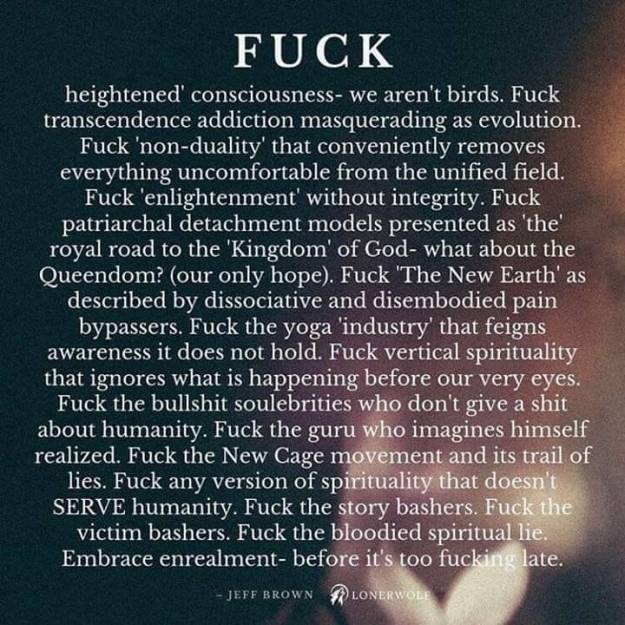
We don’t realize how deep attachment goes. Without it our ego-self wouldn’t survive, not the way we commonly experience it. People talk about letting-go of attachment as if it was a simple thing. It’s not. It goes to the root of how we commonly experience ourselves and reality.
As it is with other things that we consider doable or under our control, detachment is something that happens on its own. If we’re doing it or even just want it to happen, it simply indicates that we’re attached to something else, to another story, another image. Like the image of someone who would be free without attachment, who would be better off non-attached. That’s not freedom.
True detachment or non-attachment is not an activity. It’s something that happens spontaneously, naturally, out of inquiring into the nature of attachment and coming to a true and heartfelt understanding of it. Then in that very understanding, by and by it drops away. If it’s an activity I engage in, then it’s just another form of avoidance. Of avoidance, of denial, of rejection. Or of spiritual bypassing, to use that expression.
What we can do is explore the nature of our attachments, of our grasping and holding-on to things, to people, and inquire into the nature of attachment itself. That’s possible. And it’s already a lot.
*
It’s the nature of things that everything ends up being separated, parceled out for us, human beings. That each thing, each person appears to be a separate thing existing on its own, which leads to comparison and evaluation and preference and finally to attachment. It’s the unavoidable consequence of the mind’s capacity to reify concepts, to turn them into concrete objects that seem to exist on their own.
When you’re a young baby you perceive differences, the result of the differentiation of the formless presence of reality into countless forms, but the experience is wordless, nonconceptual. It’s a single fabric, all of one piece, and there’s no telling what is what since there’s no knowledge yet, since the perceived differences are not conceptualized yet. So there’s nothing to be attached to. Then as everything is conceptualized, reified, named and perceived through that mental filter, it all turns into what seems to be solid, concrete objects existing on their own.
Initially there is no “cat” or “dog” or “toy” or “plant.” For all these to be perceived as existing as separate things rather than as a differentiation of the one reality, we need to mentally create images or representations of them, to draw a border around them or outline them to isolate them, to abstract and extract them out of the living oneness when they’re all simply differentiated patterns in it and of it. Once that happens, then we can start to compare them, evaluate them and then judge some of them as being better or worst than others and the course is set : the oneness of reality is divided into two, split into good and bad, and then of course we choose the good over the bad, to which we get attached.
Does it sound familiar ? It reminds me of the Christian story of the tree of the knowledge of good and evil and how eating its fruit resulted in being kicked out of paradise—while it got stuck in Adam’s throat so that we’re all stuck with an Adam’s apple now. Tough luck.
*
Rich conversation. We covered a lot ground and addressed a lot of significant points, like the necessity of getting closer to our experience when simply allowing it to be as it is doesn’t, by itself, lead to its unfoldment, for things to move deeper and reveal more of themselves. That’s a vital one.
We can look at it from the perspective of disidentification. I bring that up because it’s relevant and because there’s a lot of talk about not identifying with the content of our experience in spiritual circles, and quite a bit of confusion around that as far as I can tell. In my experience and understanding, we can’t disidentify from something that comes from a deeper level than the level we’re currently at or operating from. If it does, then we need to get closer to it, to be more intimate with it, to experience it more fully so that it reveals itself. It first needs to be made conscious, brought to the light of awareness. Once you experience it and see it completely, you may find yourself going beyond it, going deeper.
I just wrote “we can’t disidentify » as if we could, although disidentification is actually not something that we can do or produce. As we saw with other things that we tend to see as being under our control, it’s not and cannot be an activity. If I’m moving away from something, then I must necessarily be identified with something else. So true disidentification can’t be an activity. The activity is in identifying and disidentification simply means that it comes to an end, that my mind doesn’t take something to be me or define me—and confine me. Then something new can happen, start to flow, to reveal itself.
So we’re not doing anything here. Nothing can be done since doing anything implies that we’re identifying with something else. It may « look like » we’re doing something, yet if we pay close attention we can recognize that it’s not the case. This is not something that may not matter much initially, yet eventually, further down the road, it changes everything.
It can be tricky to see how disidentifying is not something we do. For instance if we take what you wrote, that “I can be with that without jumping into that moving car,” which is to say without identifying with your experience, it may sound as if you’re doing something called « not jumping. » Yet are you, really ? No, you’re simply present and jumping is absent. So disidentification is simply the absence of identification.
There’s this revealing relation between the words identification, identical and identity. What’s our usual sense of identity after all ? It’s our mind saying that a given state or feeling or thought and us are identical. It’s our identity. It’s how we identify ourselves. This is what identification is : our mind grasping, grabbing something and using it to define ourselves—and as it bears repeating, confine ourselves too.
*
That sounds good. As I once wrote, « the wonder, the plain miracle is that what is, exactly as it is, this obvious truth here and now, no matter what, always leads to greater and deeper truth and ultimately all truth—not that there’s an end to it—for the sincere, open and inquiring heart. Unfailingly. »
There isn’t all this talk about letting-go and surrender and dropping all resistances and defenses for nothing. Taken simply it all points to the truth, to the fact that what is, is. At some point, call it grace or good fortune, we get that, and in getting that, things are finally allowed to be exactly as they are and to move and transform whichever way, spontaneously, naturally. Although that’s if—and that’s a big if—there’s not too much material blocking the dynamic flow of reality, energetically, emotionally, psychologically. If there is, then that needs to be addressed.
While every spiritual approach brings our attention to particular aspects of reality, obviously their function is also to address whatever blocks the perception of these aspects and of reality as a whole. Reality is already here. Full on. So what’s in the way ?
As someone once had it, pointedly enough : the question is not how to wake up or realize what the true nature of reality is, the question is how do we manage to miss it ? what’s our trick ?










 Ati Supino (Dion)